Details
Léon & Lévy, later Lévy & Fils, was a French family firm of publishers, photographers and printers active from 1864 to 1913.
The firm Léon & Lévy was founded in 1864 by Isaac, known as Georges Lévy (trademark J. Lévy), and his father-in-law Moyse Léon* Both had previously worked at the photographic studio Ferrier & Soulier, specialists in stereoscopic views in Paris, whose stock they purchased in 1864. Already possessing an extensive catalogue, they obtained the concession for the 1867 Exposition Universelle, and in 1869 commissioned views of the inauguration of the Suez Canal from the photographer Bisson. Their catalogue soon grew to include 30,000 photographs.
With the arrival of the two sons, Abraham Lucien and Gaspard Ernest, the company shifted towards the postcard market. The trademark L.L., standing for Lévy & ses Fils, was registered in 1897, and the Lévy firm at 25 rue Louis-le-Grand in Paris became the second-largest postcard publisher in France.
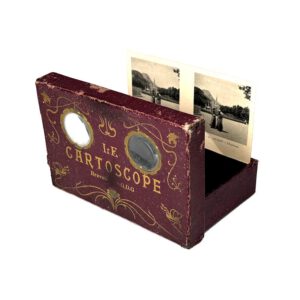
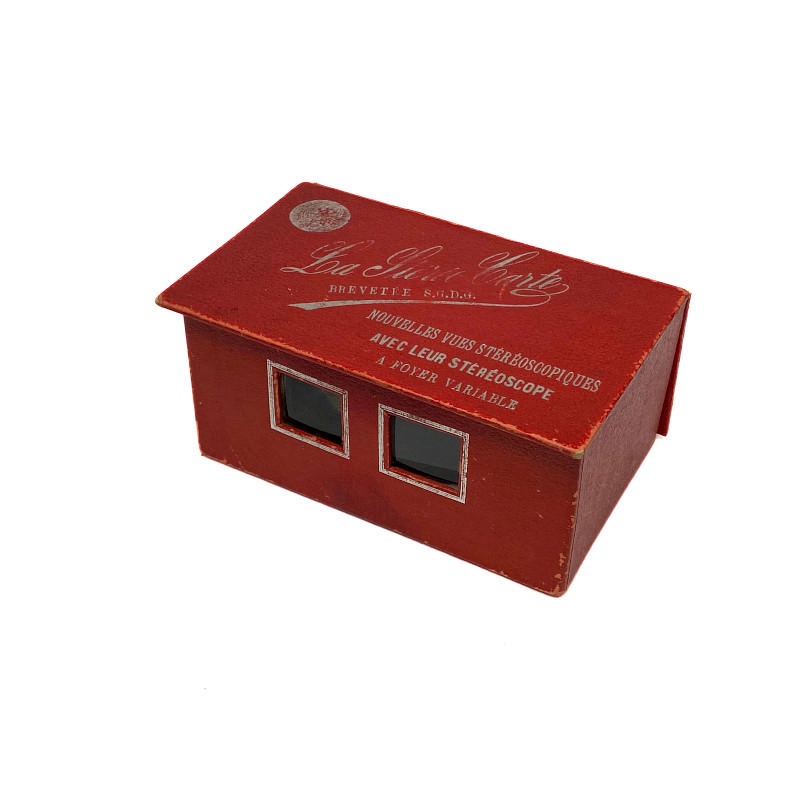
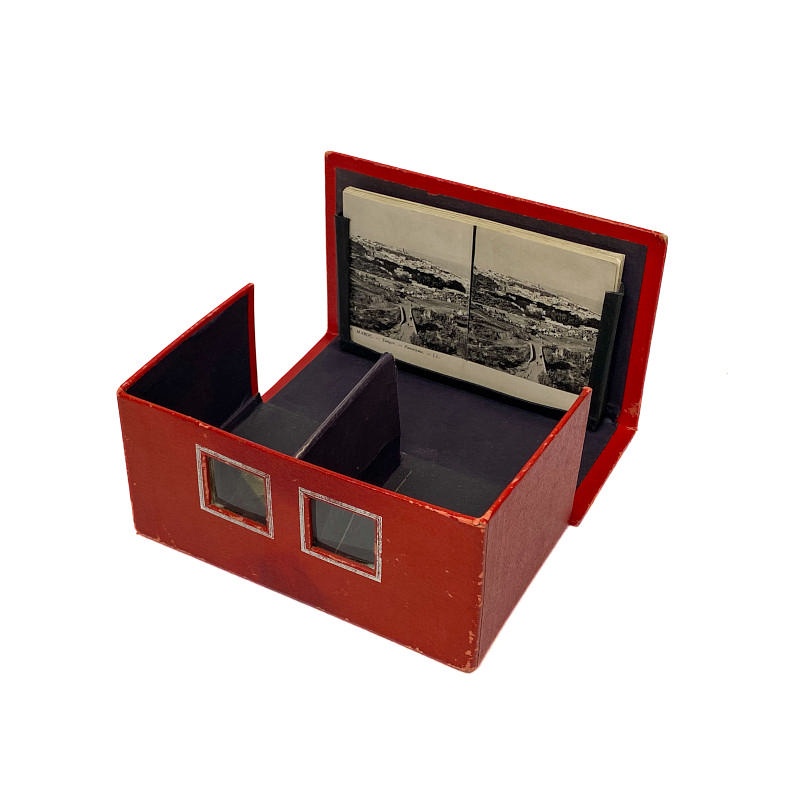
On 25 October 1898, Lévy & Fils filed patent FR 282,431 for a “storage box for stereoscopic photographic prints, distinguished by the fact that the box itself forms the viewing apparatus for these prints.” The concept was registered under the name La Stéréo-Carte.
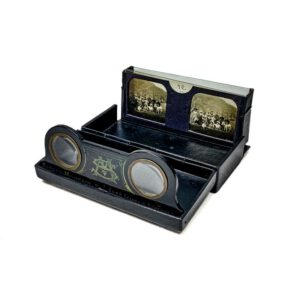
The Stéréo-Carte takes the form of a cloth-covered cardboard box that unfolds at the rear. It contains a supply of stereoscopic postcards, with the front of the box fitted with prisms for viewing them. A central partition between the prisms separates the two images. The device was used to promote and distribute stereoscopic cards published by Lévy & Fils.
(from: Moulinier et al. Histoires de visionneuses stéréoscopiques françaises. Limoges, 2025, p. 217. Author’s translation.)