Details
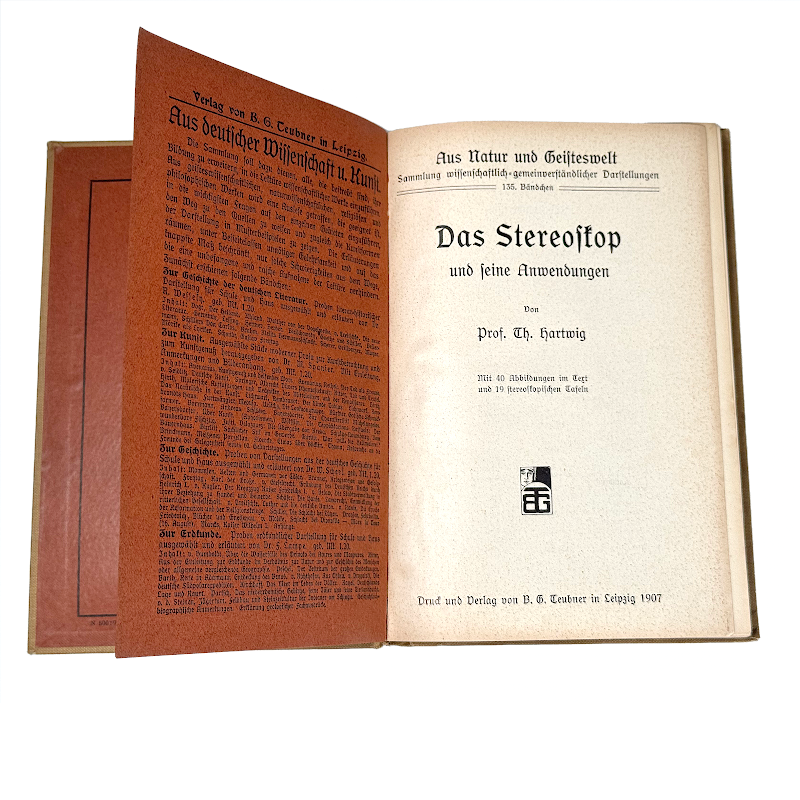
Published in 1907 by B. G. Teubner in Leipzig, Das Stereoskop und seine Anwendungen (“The Stereoscope and its Applications”) by Theodor Hartwig is an illustrated introduction to the principles and practical uses of stereoscopy. It formed volume 135 of the popular-science series Aus Natur und Geisteswelt.
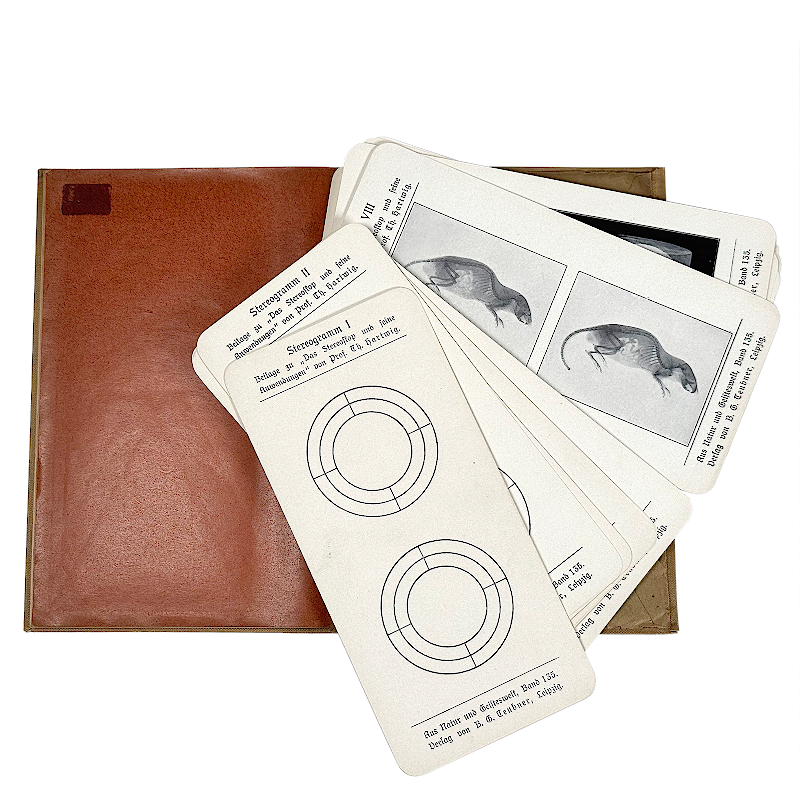
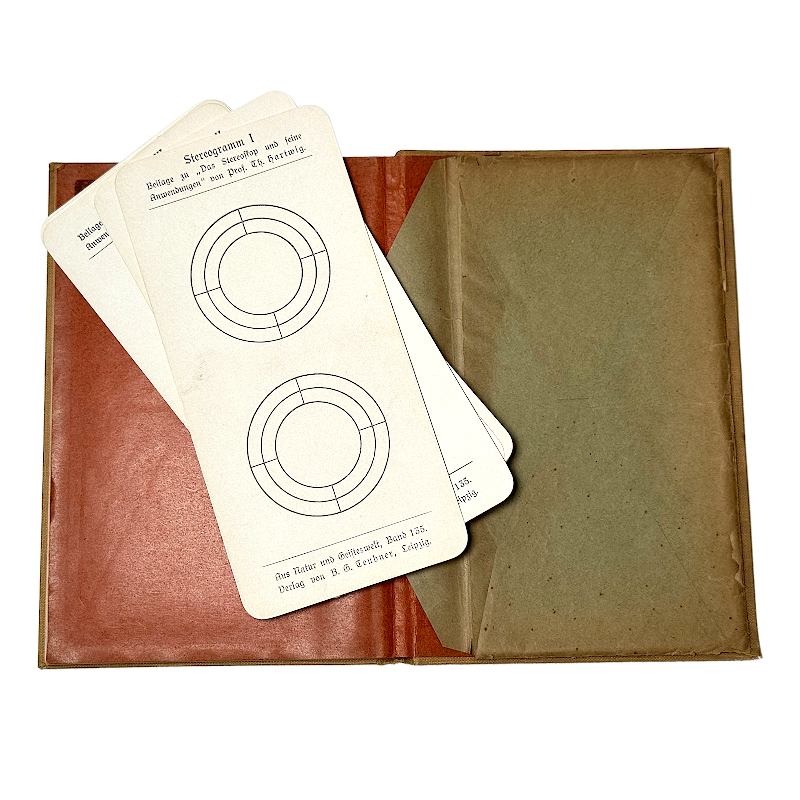
The book contains 40 illustrations within the text and was supplied with 19 loose stereoscopic plates, stored in a pocket inside the rear cover. These were intended not merely as illustrations, but as practical demonstrations to be viewed stereoscopically while following Hartwig’s explanations. Some use simple geometrical figures to demonstrate binocular depth perception, while others reproduce photographic subjects illustrating scientific and technical applications of stereoscopy, including stereoscopic X‑ray images.
Hartwig discusses both the optical principles of stereoscopic vision and a remarkably broad range of applications, including stereoscopic photography, astronomy, microscopy, measurement, photogrammetry and the stereocomparator. The combination of explanatory text, diagrams and actual stereo pairs makes the volume both a textbook and a practical demonstration set.
Historical Context
By the beginning of the twentieth century, stereoscopy had expanded beyond popular entertainment and was increasingly used in science and technology. Applications included astronomy, microscopy, photogrammetry and stereoscopic X‑ray imaging, where the perception of spatial relationships offered advantages over conventional two-dimensional images.
Hartwig’s book appeared in this period of transition. Theodor Hartwig (1872–1958) was a teacher of mathematics, geometrical drawing and natural science and was active in popular education. His interest in stereoscopy was not purely theoretical: in 1907 he was granted leave for further study and worked at the Military Geographical Institute in Vienna, where he investigated a new stereocomparator made by Carl Zeiss. The instrument allowed corresponding points in stereoscopic photographs to be compared and measured with considerable precision and became particularly important in photogrammetry.
The publication itself reflects the educational ambitions of Teubner’s Aus Natur und Geisteswelt, a long-running series of accessible introductions to scientific and cultural subjects published from 1898. By supplying Hartwig’s volume with a set of actual stereograms, the publisher allowed readers to reproduce the phenomena described in the text for themselves. The book therefore documents an important moment when stereoscopy occupied an unusual position between popular visual entertainment, experimental science and precision measurement.