Details
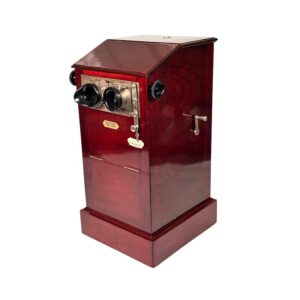
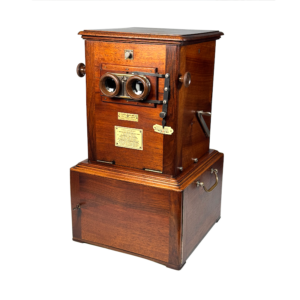
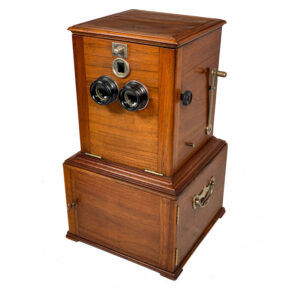
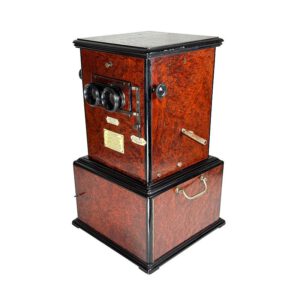
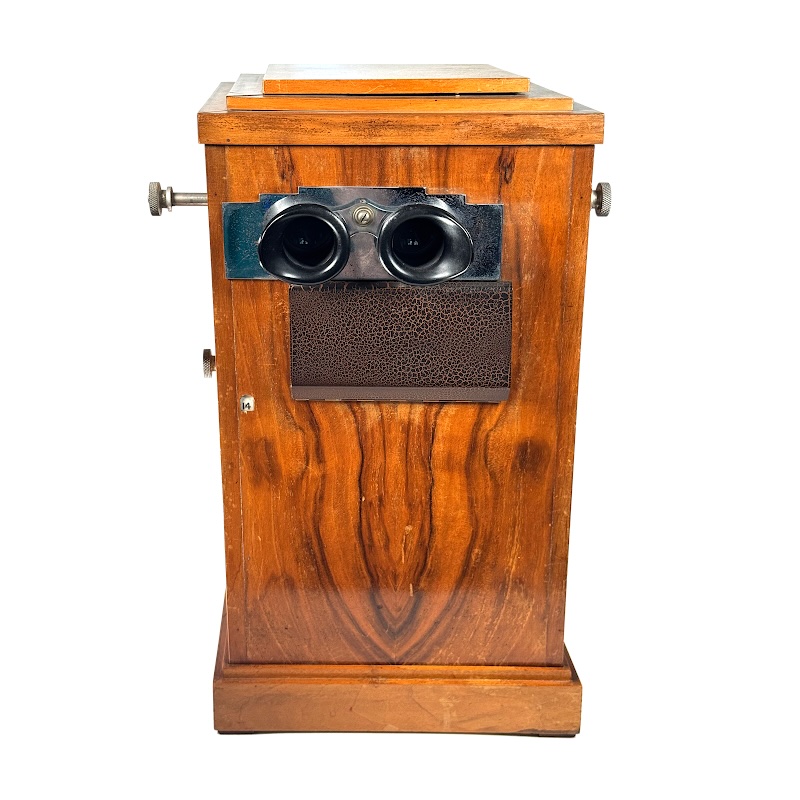
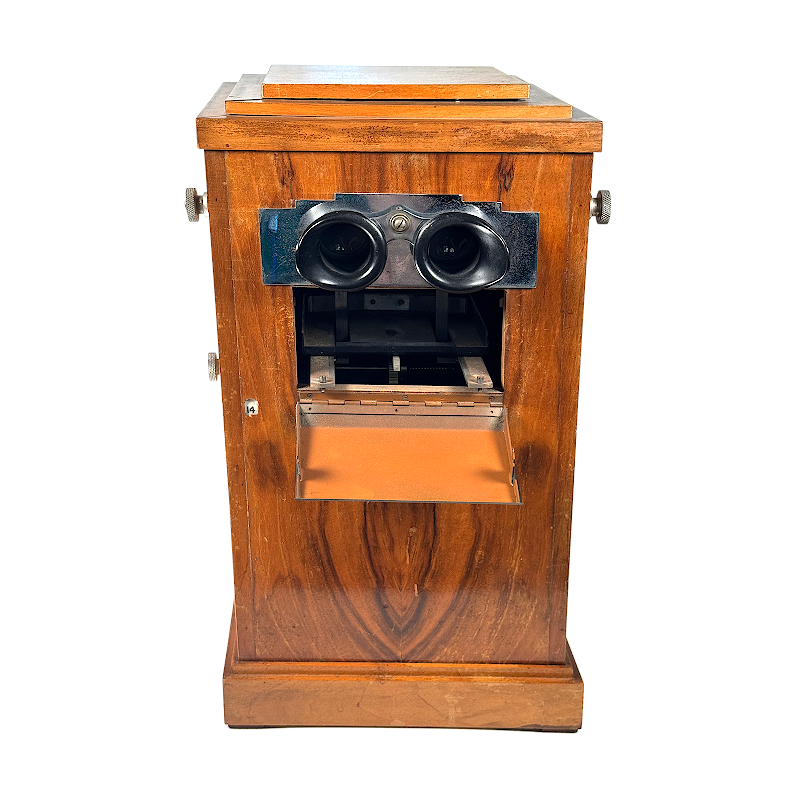
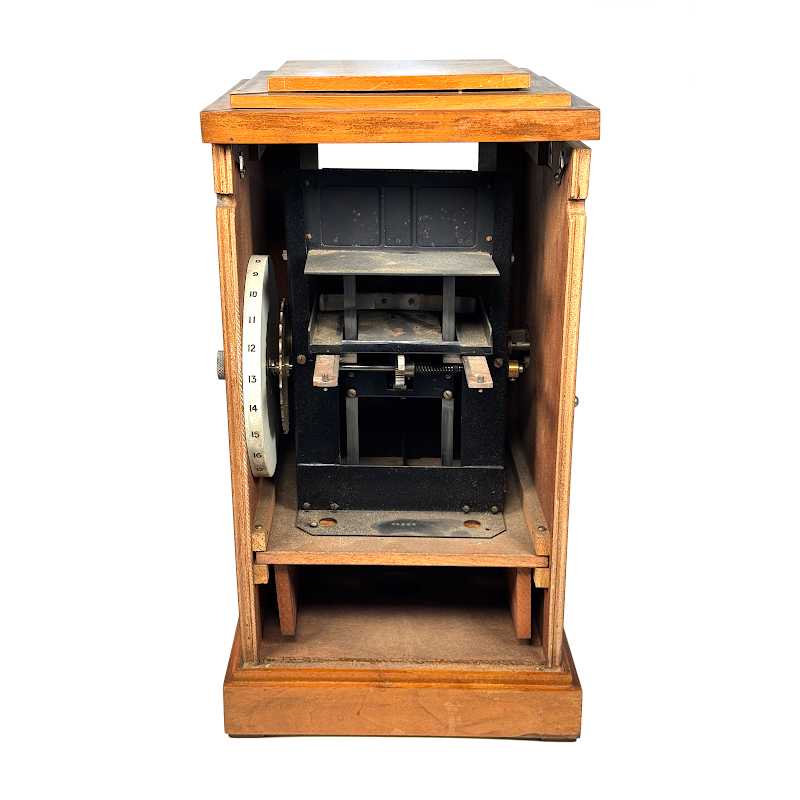
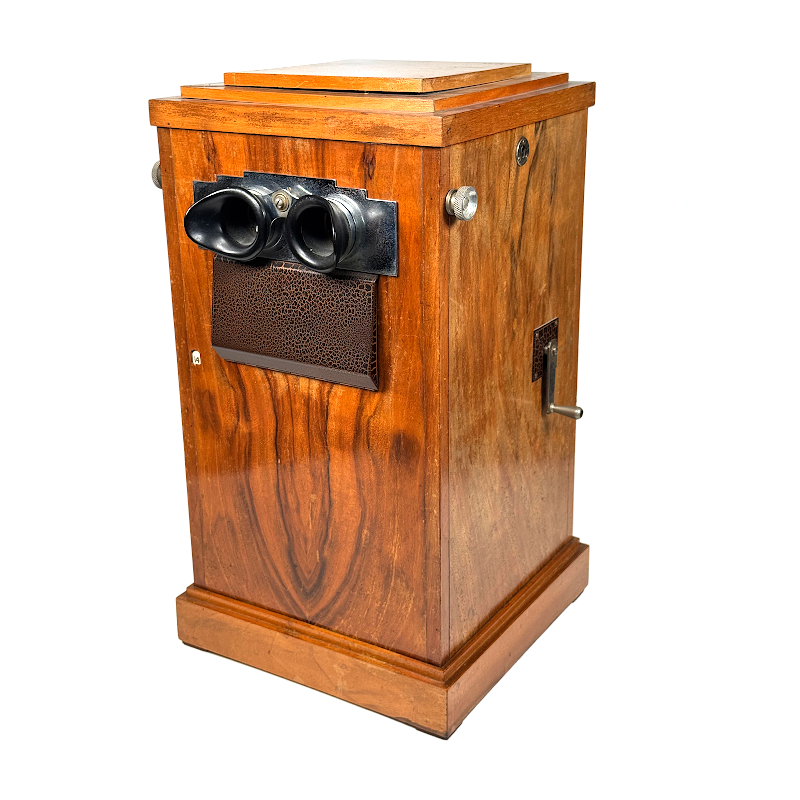
The Taxiphote Richard-Chauvelon is a special version of the Taxiphote simplifié, retaining its basic mechanism and convenient crank operation. A bakelite tray containing 25 glass slides is inserted through a small flap made of lacquered metal directly below the eyepieces. The entire front panel can also be removed for maintenance, after releasing the hooks securing it from inside the cabinet.
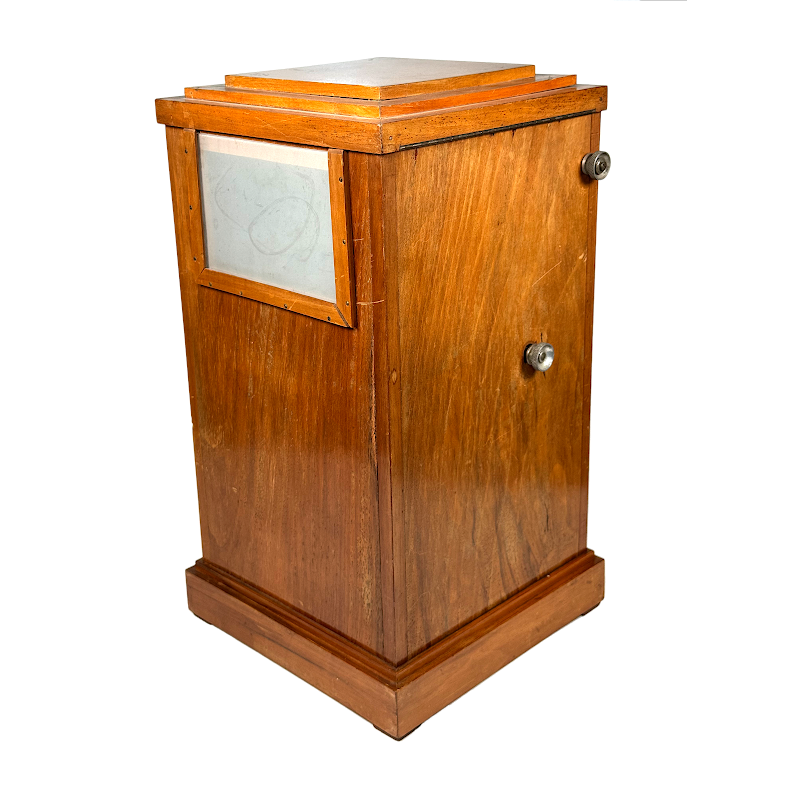
The counter indicating the number of the current slide has been relocated inside the cabinet and can now be read through a small window on the front. Its control knob remains on the left side, allowing direct access to individual slides. To read the title of a slide, the entire eyepiece assembly can be shifted to the left by pulling a knob on the left side of the cabinet.
The cabinet has a distinctive Art Deco design with straight lines, a stepped top and base, and a largely unornamented wooden surface. The model was available for 45x107mm and 6x13cm glass slides, with a choice of varnished or waxed mahogany or waxed walnut.
In-depth information on the Taxiphote can be found here: Le Taxiphote — the most famous French stereo viewer
Historical Context
Following the success of his Vérascope stereoscopic camera, Jules Richard and his engineer Louis Colardeau developed the first Taxiphote, patented as the Stéréo-Classeur in 1899. Renamed Le Taxiphote in 1900, it became one of the most successful French stereoscopic viewing systems and remained in production for around four decades.
The Taxiphote simplifié, introduced in 1908, featured a convenient crank mechanism instead of the lever used in earlier models. Designed as a more affordable alternative, it became the basis for the Richard-Chauvelon, a special version introduced in 1936 and presented at the Salon de la Photo in Paris. Chauvelon had already been involved in the technical development of several Richard products, including the Inverseur automatique in the 1910s and the Homéos product line around 1920. The Taxiphote Richard-Chauvelon thus continued a collaboration dating back more than two decades.
The new model combined the proven mechanism of the Taxiphote simplifié with several practical improvements and a modern cabinet reflecting the Art Deco style of the period. Although officially designated Taxiphote Richard-Chauvelon, its distinctive appearance led to it becoming widely known as the Taxiphote Art Deco. The model was also described in the 1937 catalogue as the simplest in the Taxiphote range.
The Richard-Chauvelon illustrates how Jules Richard continued to adapt the established Taxiphote system to contemporary design preferences and practical requirements during the final years of the stereoscopic era before the Second World War.