Details
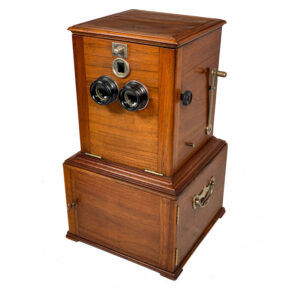
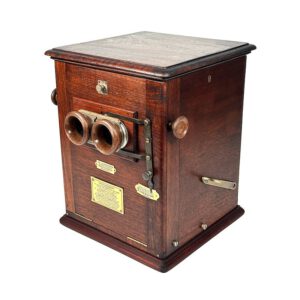
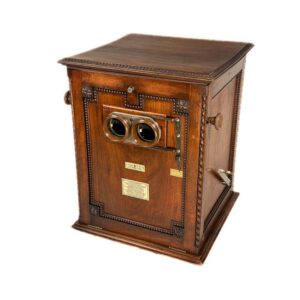
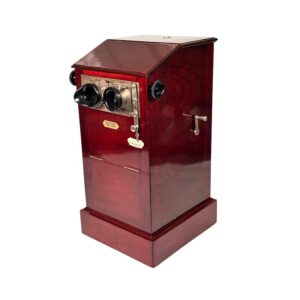
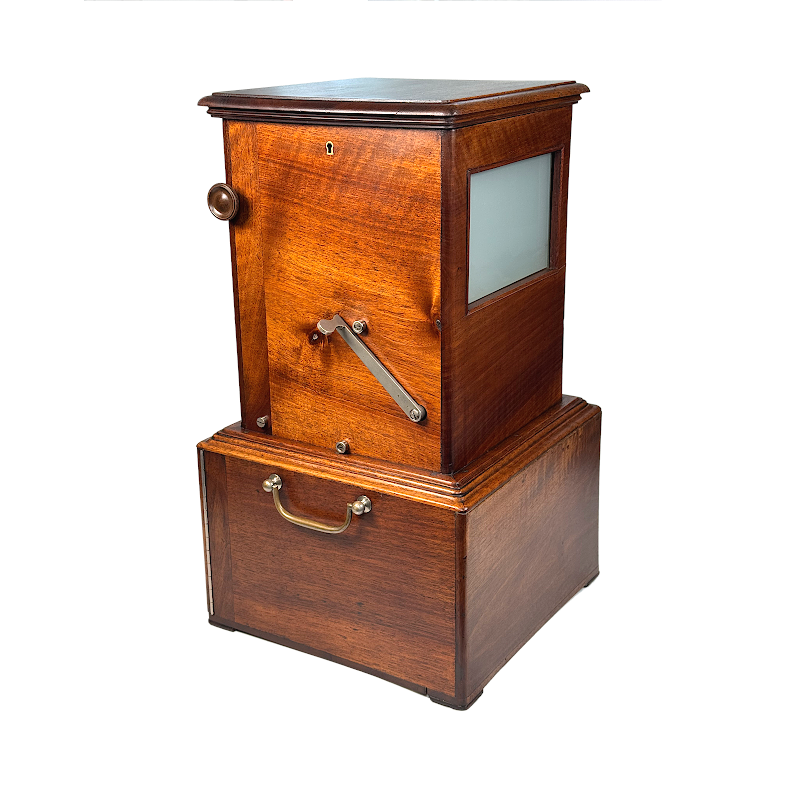
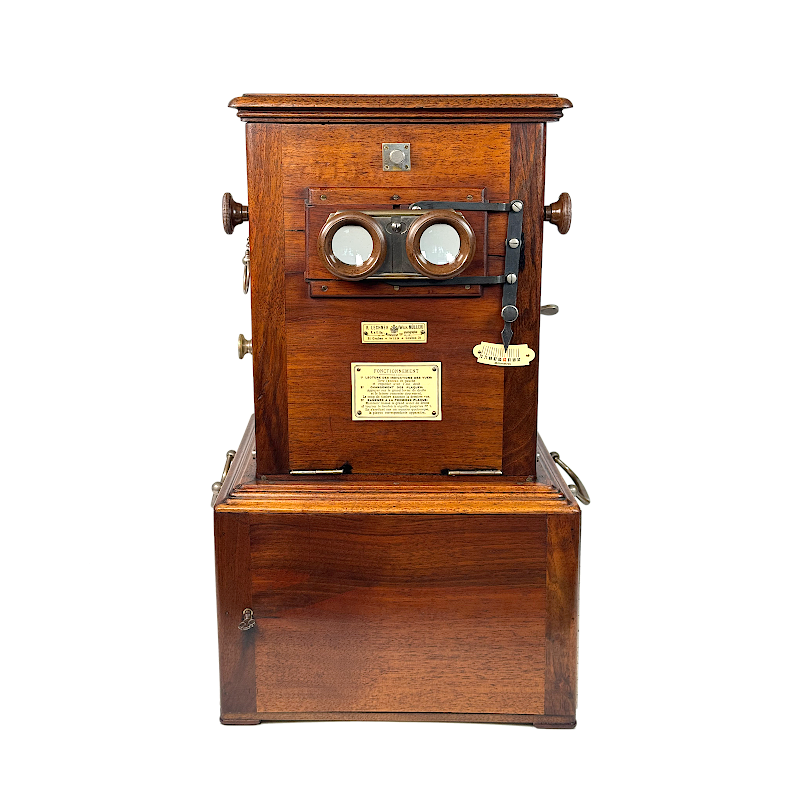
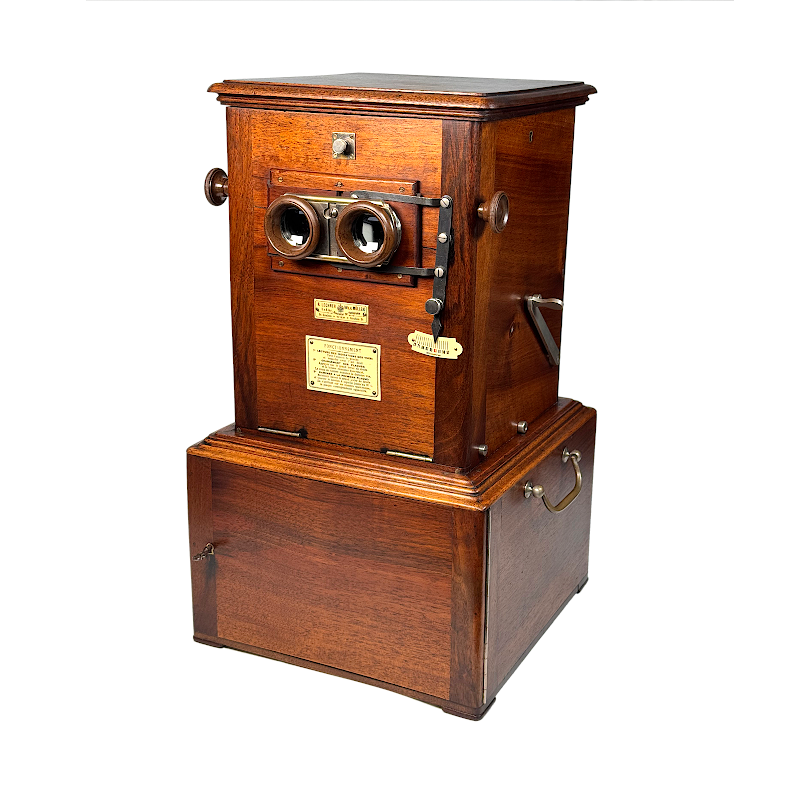
A bakelite tray containing 25 glass slides can be inserted by flipping down the front of the viewer. In the early version of the Taxiphote mécanique, the instrument is operated using a lever on the right side of the housing, similar to that of the standard Taxiphote. The first half of the lever’s movement lifts the slide, while the second half moves it towards the oculars. The transition between these two movements can be felt as a change in resistance, requiring some practice to achieve smooth operation. The optical quality and resulting viewing experience with the are among the finest of all Taxiphote models.
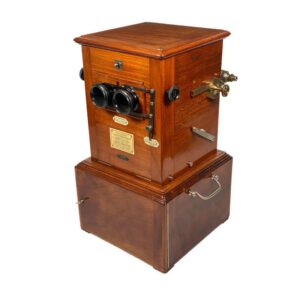
Around 1911, the lever was replaced by the crank mechanism introduced with the Taxiphote simplifié in 1908. This second version makes operation considerably smoother and more comfortable.
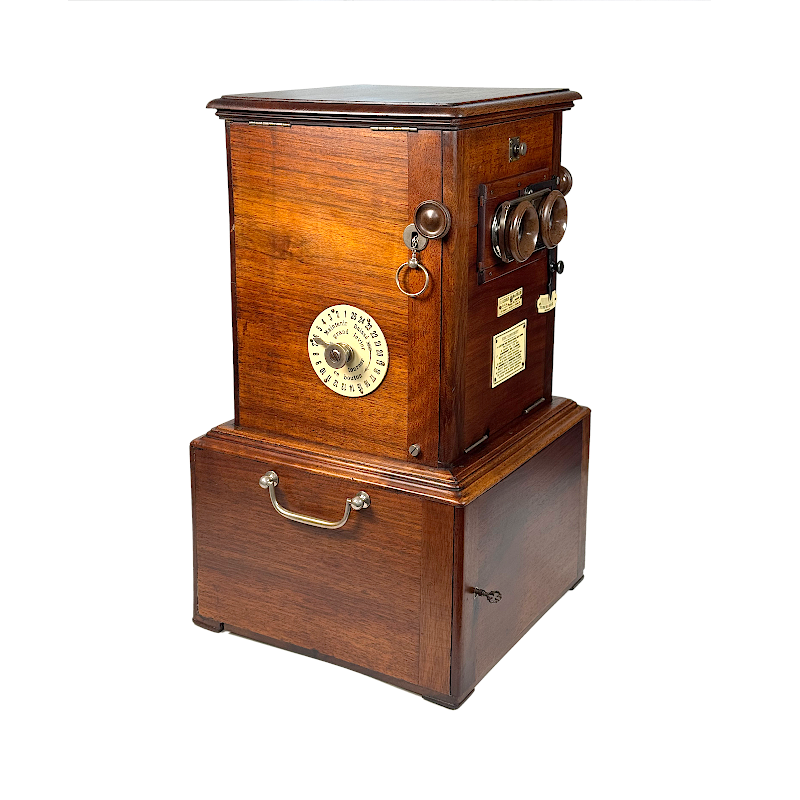
On the left side of the viewer, there is a counter which indicates the number of the slide and allows navigation to a specific slide while the centre knob is pressed. Pulling a metal chain on the left brings a mirror into position allowing the slide title to be read through the right ocular.
In-depth information on the Taxiphote can be found here: Le Taxiphote — the most famous French stereo viewer
Historical Context
Shortly after the success of the Vérascope stereoscopic camera, Jules Richard and his engineer Louis Colardeau patented the first model as Stéréo-Classeur in 1899 and started production in the same year. It was renamed as Le Taxiphote in 1900 and remained in production for around 40 years.
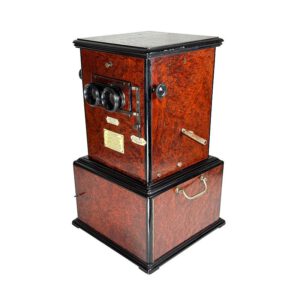
There were two attempts to enlarge the vision of the 45x107mm format listed as court foyer (short focus). One was the Modèle optique using additional lenses for magnification. The other was the Modèle mécanique which was the only short focus model in the literal sense, because it indeed moves the slide closer to the oculars. It remains unclear which of the two was introduced in the 1906 catalogue, because both mechanisms were already patented by that year. However, in 1908, both models appear in the catalogue. All models were available in two standard versions, one in waxed walnut and one in polished mahogany. There were also deluxe versions with changing designs such as inlaid patterns of different woods or additional ornaments.
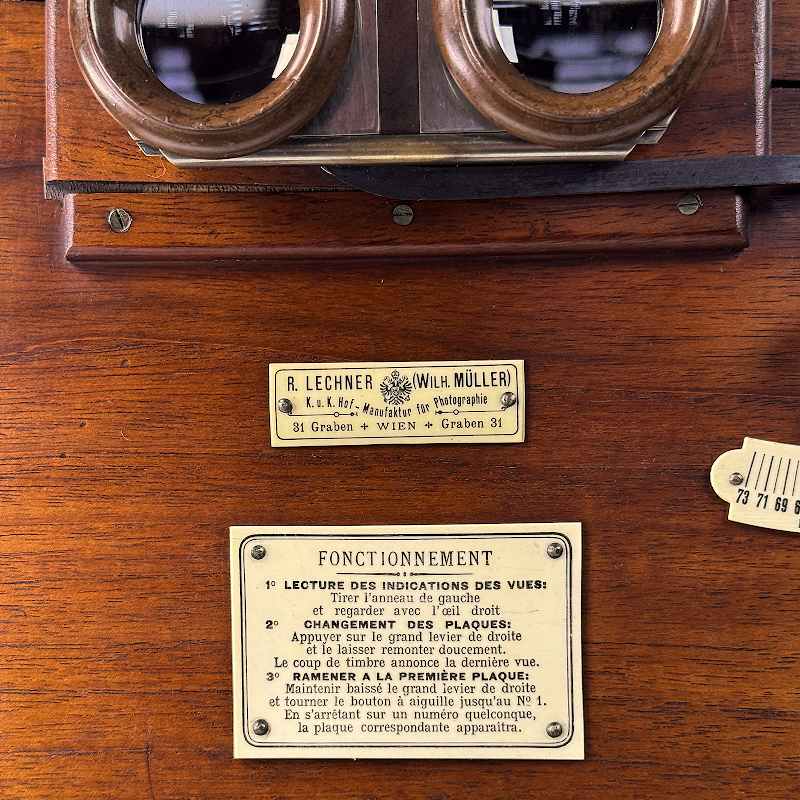
The viewer illustrated was most likely produced around 1907, according to its serial number. It was exported and sold in Vienna by Lechner & Müller, illustrating the influence of French innovations in stereoscopic technology across Europe.