Details
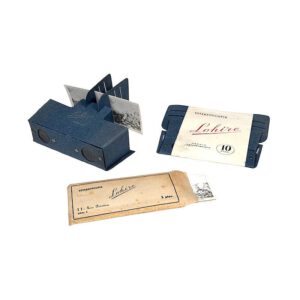
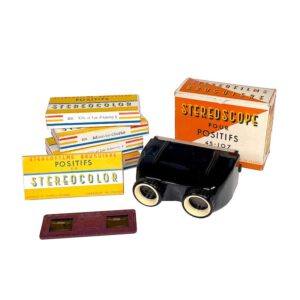
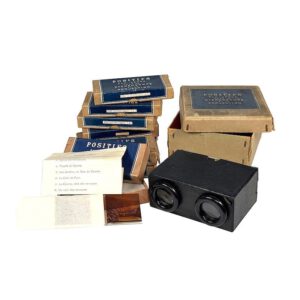
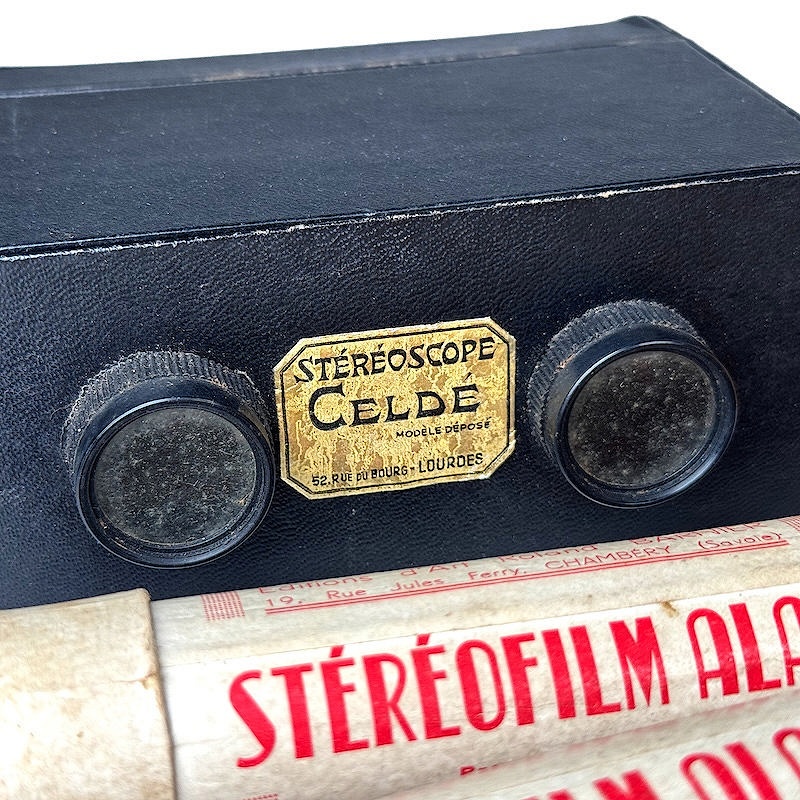
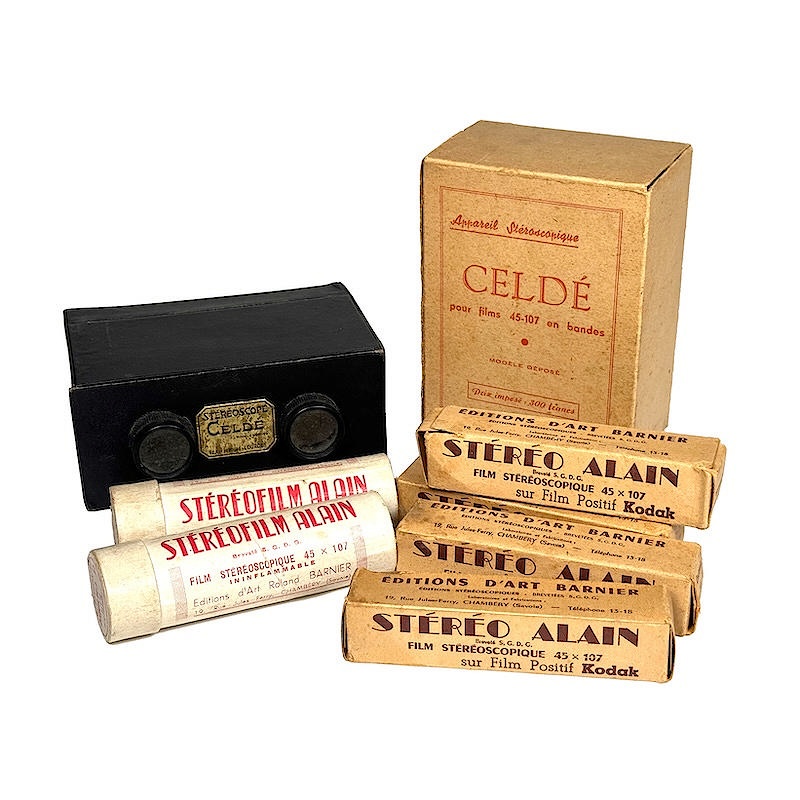
At around the same time as the Stéréo-Plastique Alain, circa 1950, another publishing house, Éditions d’Art Celdé, whose address was in Lourdes at 52 rue du Bourg, appeared. Like Roland Barnier, this publisher offered postcards and stereoscopic film strips in the 45x107mm format, produced on positive Kodak film and depicting similar subjects. One can also note the similarity of the packaging and the compatibility of the films, which can be viewed in both stereoscopes despite the different designs of the two viewers. The Celdé stereoscope is made of cardboard covered with paper. This raises a question: were the two companies part of the same business, or were they linked by a commercial agreement?
The stereoscope produced by Éditions Celdé appears to have been based on a patent by Paul Sylvain Sabathier of Toulouse, who filed his French patent FR 1.041.869 on 14 August 1951 for a stereoscopic apparatus using film with transverse movement. The patent incorporates the use of cardboard construction, focusing by means of a sliding drawer with an adjustment at the rear, and a mechanism for vertically advancing the flexible stereoscopic film — the same format used by Éditions Celdé.
(from: Moulinier et al. Histoires de visionneuses stéréoscopiques françaises. Limoges, 2025, p. 204. Author’s translation.)