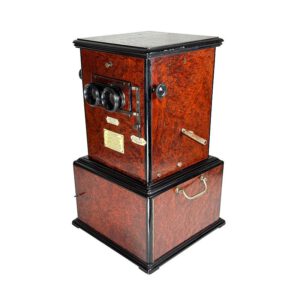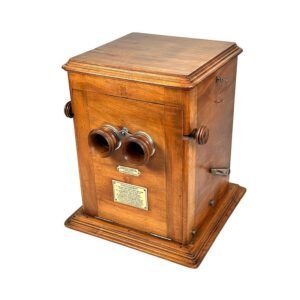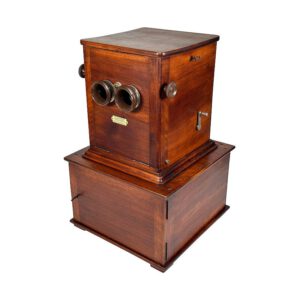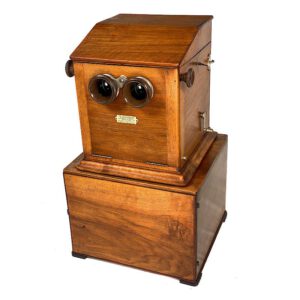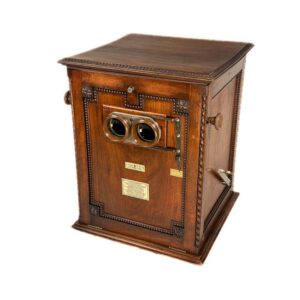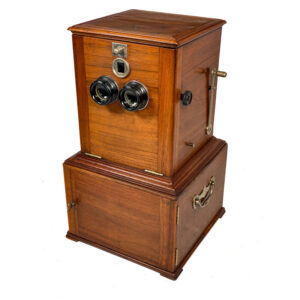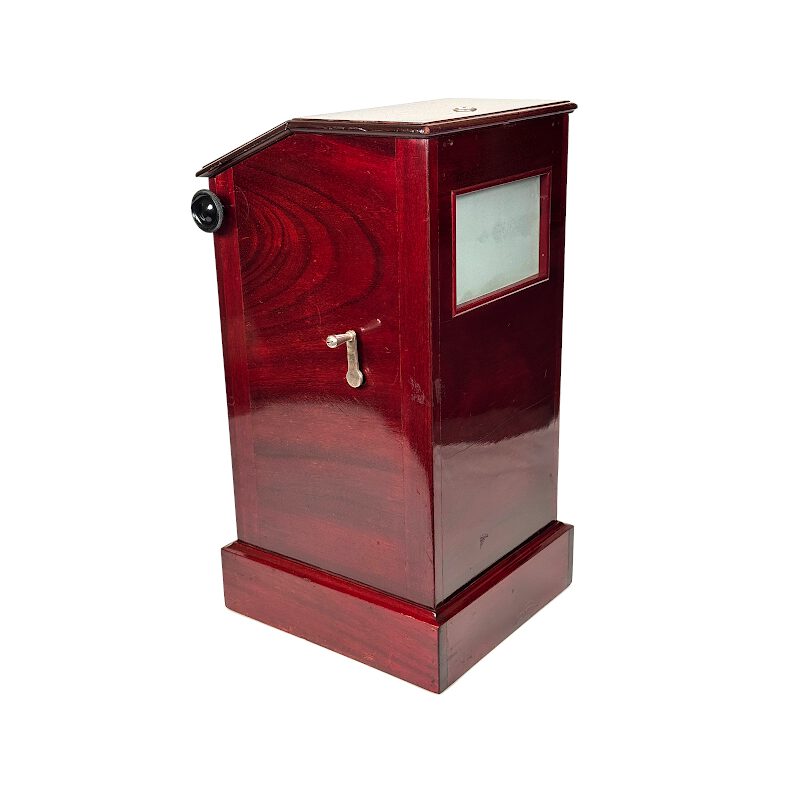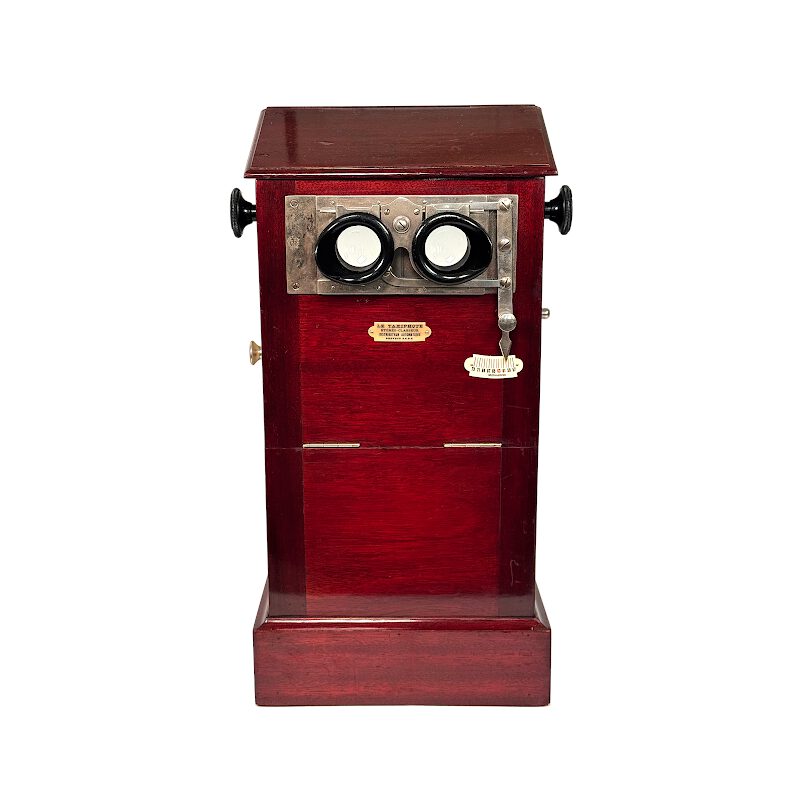
Tray-Stereoscope ‚Le Taxiphote, modèle surélevé‘
Details
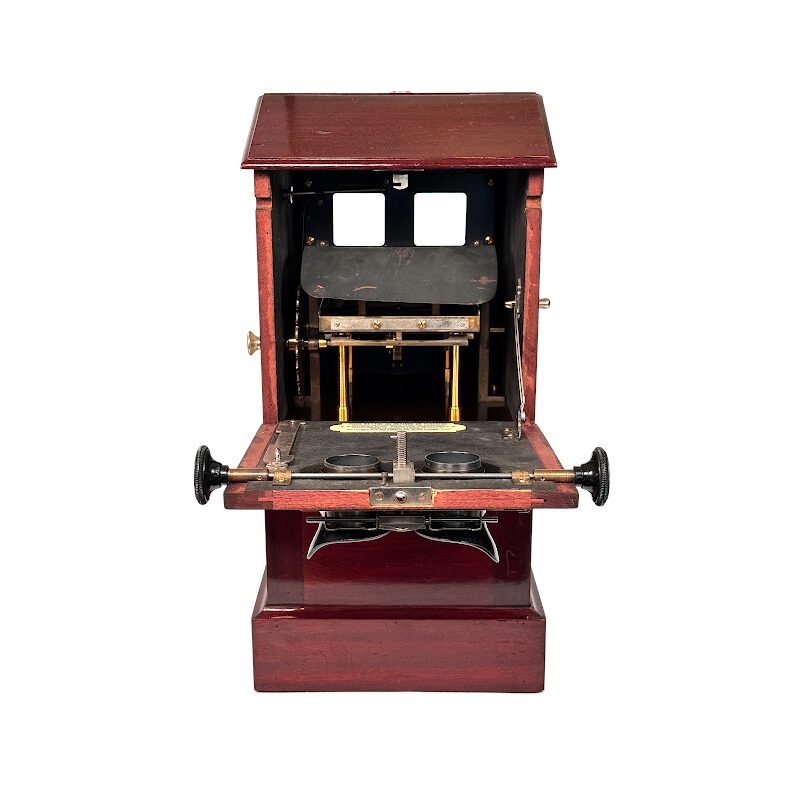
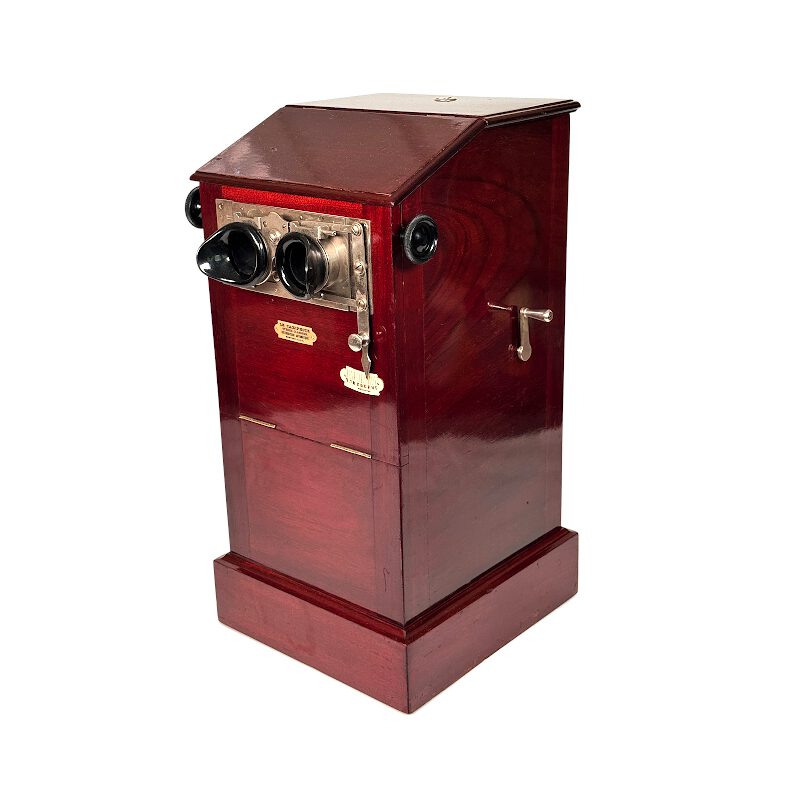
A bakelite tray containing 25 glass slides can be inserted by flipping down the front of the viewer. Then, by turning a crank on the right side of the housing, one slide after another can be examined. On the left side of the viewer, there is a counter which indicates the number of the slide and allows navigation to a specific slide while the centre knob is pressed. There is also a smaller knob on the left which serves to swing aside a black mask inside the viewer allowing the slide title to be read.
According to its serial number, this viewer was produced around 1930.
In-depth information on the Taxiphote can be found here: Le Taxiphote — the most famous French stereo viewer
Historical Context
Shortly after the success of the ‘Vérascope’ stereoscopic camera, Jules Richard and his engineer Louis Colardeau patented the first model as ‘Stéréo-Classeur’ in 1899 and started production in the same year. It was renamed as ‘Le Taxiphote’ in 1900 and remained in production for around 40 years. The patent for the ‘Modèle simplifié’ was applied for in 1907 and 1908 and was granted in January 1909. It was introduced as a novelty in the 1908 catalogue and was also listed as ‘Modèle 1908’ for a while. The mechanism of the ‘surélevé’ model is identical to that of the ‘simplifié’. The only difference is that the housing is taller, so the oculars are at a more comfortable height for viewing. This new design appeared around 1930.
The new crank mechanism is quite comfortable to use compared to the common lever mechanism found in the other models. However, the ‘Modèle simplifié’ was also announced to be the most affordable model and therefore always lacks any milled edges. The viewer illustrated is the very cheapest version which comes even without the adjustable ocular distance.