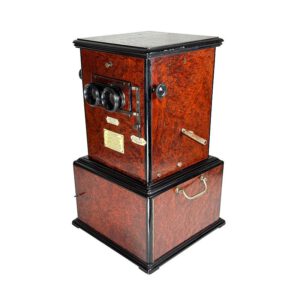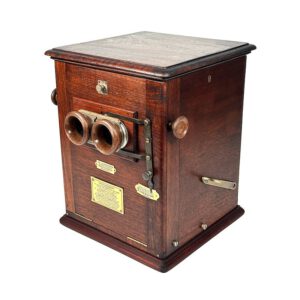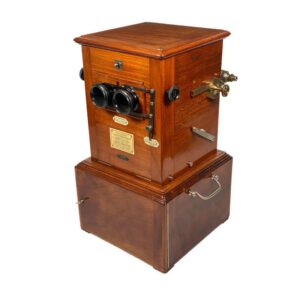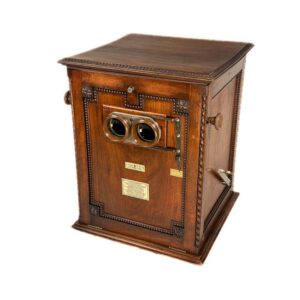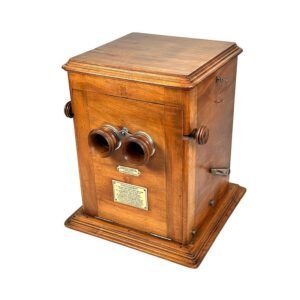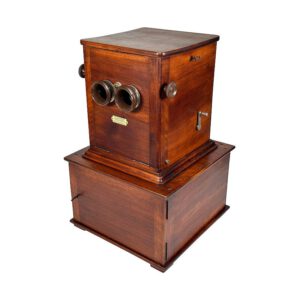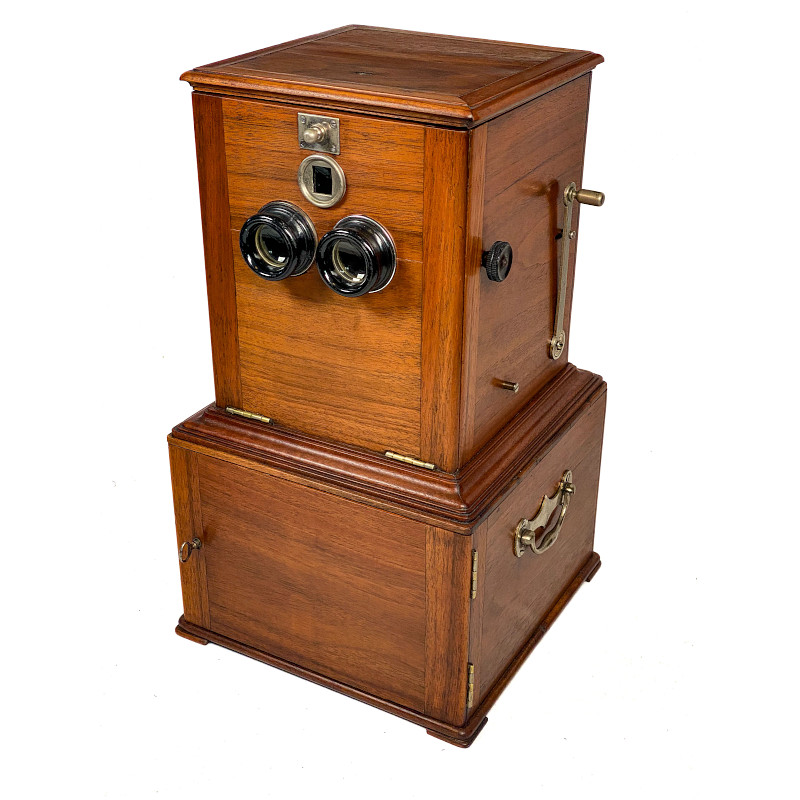
Tray-Stereoscope, Prototype for ‚Le Taxiphote, modèle mécanique‘
Details
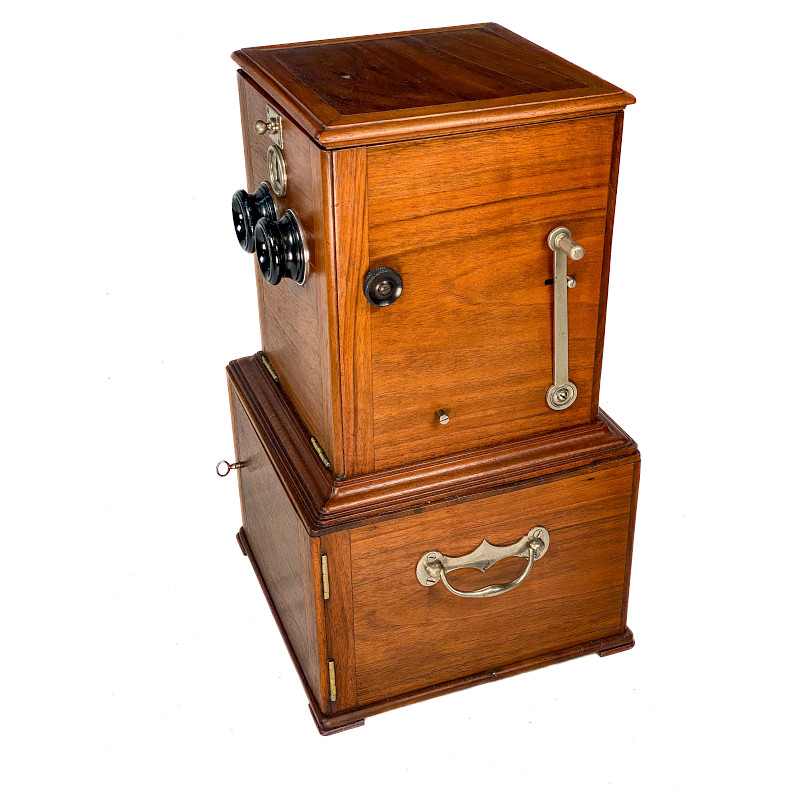
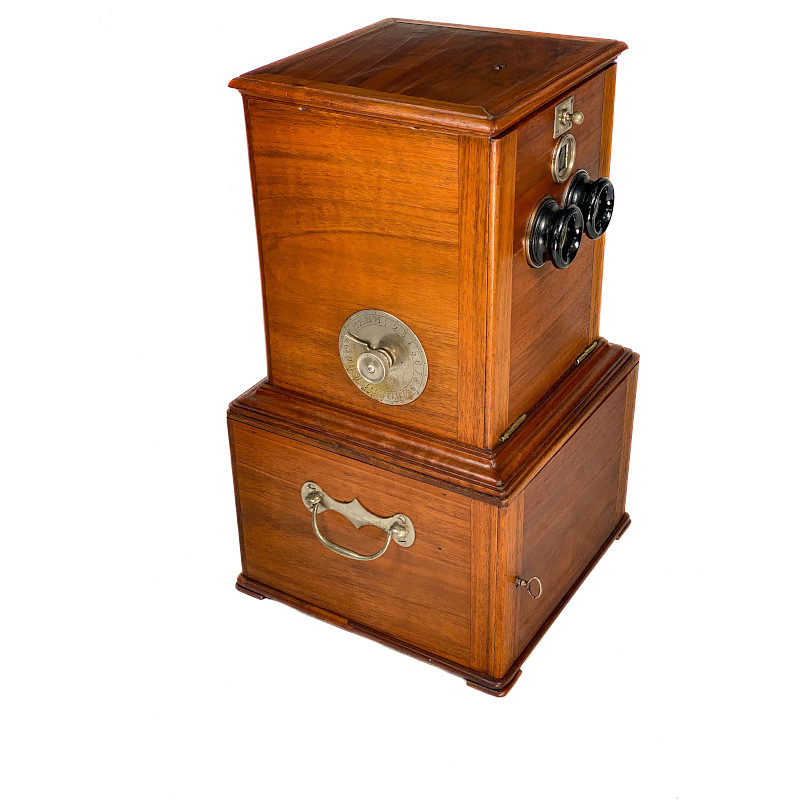
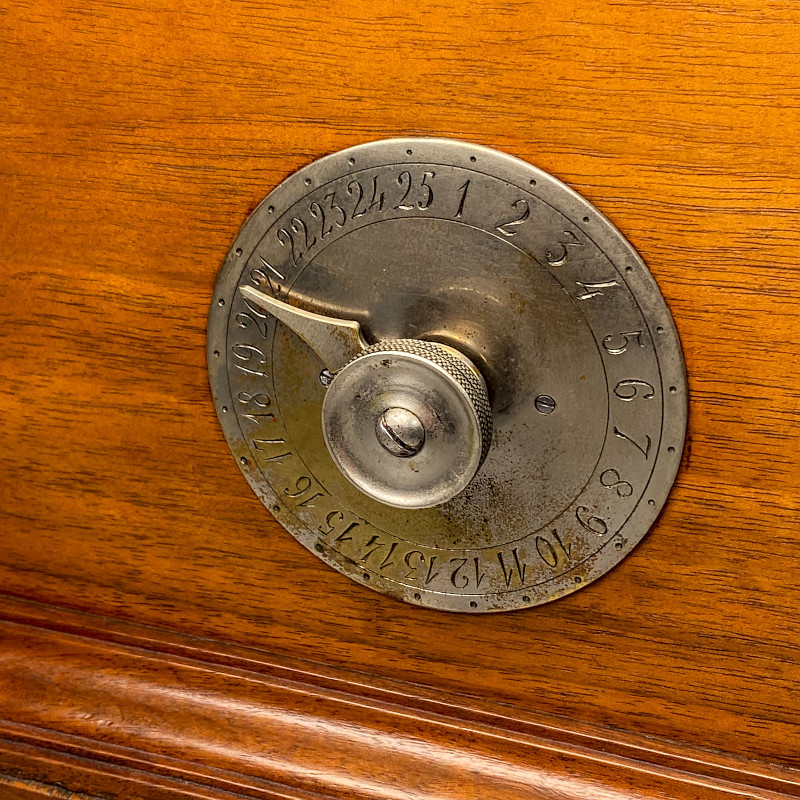
A bakelite tray containing 25 glass slides can be inserted by flipping down the front of the viewer. Then, by depressing the lever on the right side of the housing, one slide after another can be examined. On the left side of the viewer, there is a counter which indicates the number of the slide and allows navigation to a specific slide. The slide title can be read through a prism leading to a third ocular above the eyepieces.
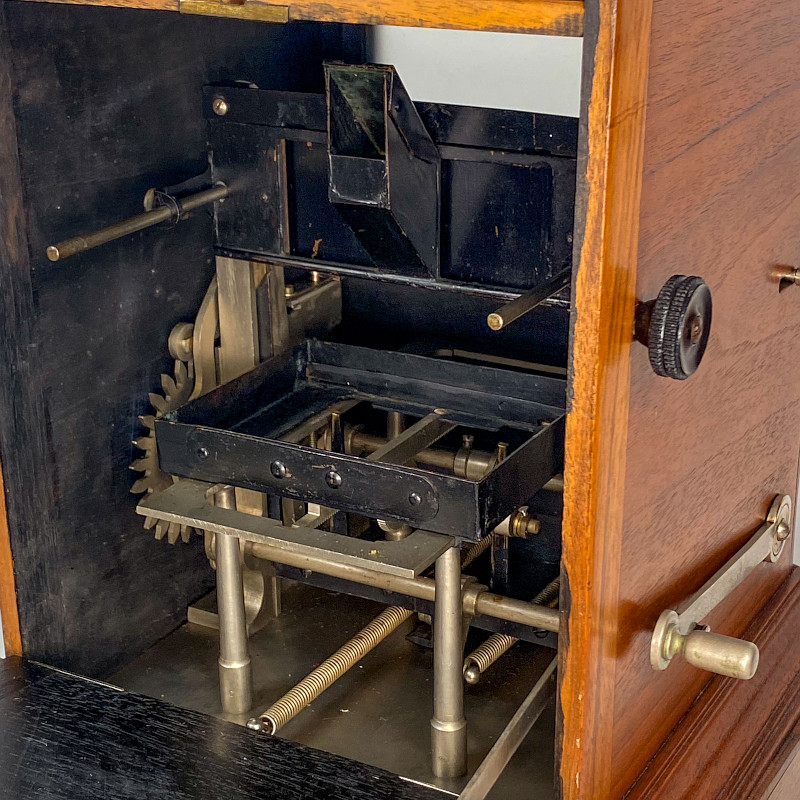
Although the oculars are fixed to the front of the viewer, there is an unusual focussing system directly affecting the slide transport mechanism. A knob on the right side is connected to a metal pin behind the lever. It prevents the lever from moving completely upwards. Thus, the slide carrier stops its movement towards the oculars at a certain position which works similar to the common focussing by lens movement.
The base of the viewer has three drawers with four trays each, making it possible to store a total of 300 slides.
In-depth information on the Taxiphote can be found here: Le Taxiphote — the most famous French stereo viewer
Historical Context
Shortly after the success of the ‘Vérascope’ stereoscopic camera, Jules Richard and his engineer Louis Colardeau patented the first model as ‘Stéréo-Classeur’ in 1899 and started production in the same year. It was renamed as ‘Le Taxiphote’ in 1900 and remained in production for around 40 years.
There were two attempts to enlarge the vision of the 45x107mm format listed as ‘court foyer’ (short focus). One was the ‘Modèle optique’ using additional lenses for magnification. The other was the ‘Modèle mécanique’ which was the only short focus model in the literal sense, because it indeed moves the slide closer to the oculars. It remains unclear which of the two was introduced in the 1906 catalogue, because both mechanisms were already patented by that year. However, in 1908, both models appear in the catalogue. The crank operation system of the ‘Modèle simplifié’ was adopted to the ‘Modèle mécanique’ shortly after 1911.
Back in 1905 there was a third patent which seems to have been abandoned and never got into production. Surprisingly, the viewer illustrated exactly matches these patent drawings. It shows no label, serial number or any references at all. Although the mechanism obviously was made professionally, some minor modifications obviously were made by hand afterwards. Therefore, it can be assumed that this viewer was still part of an ongoing development process.
There are some further indications that suggest that this is an early prototype for the ‘Modèle mécanique’. If this is true, it is fortunate that it still exists today.