Details
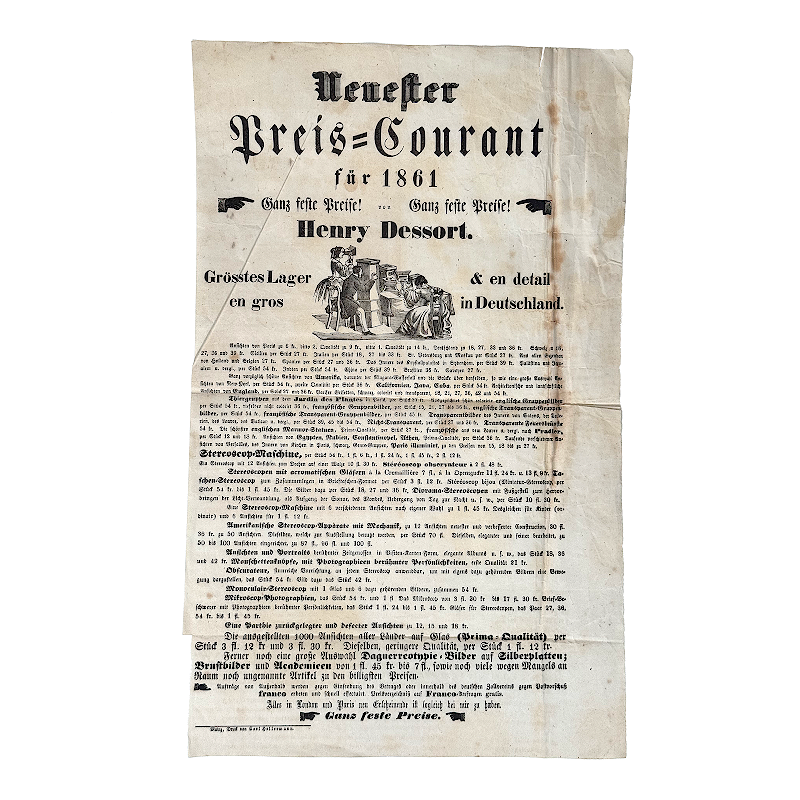
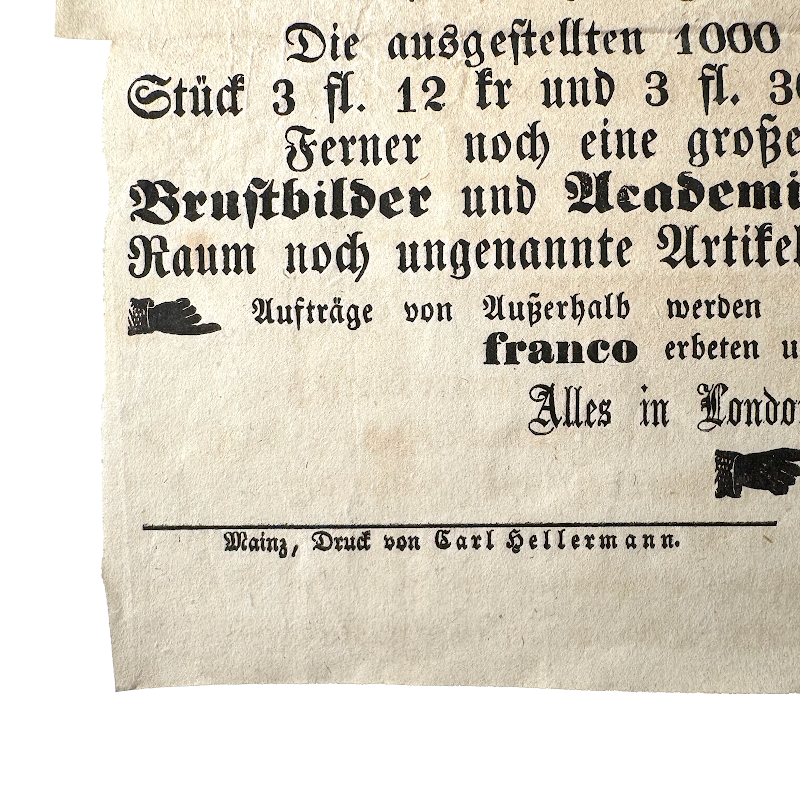
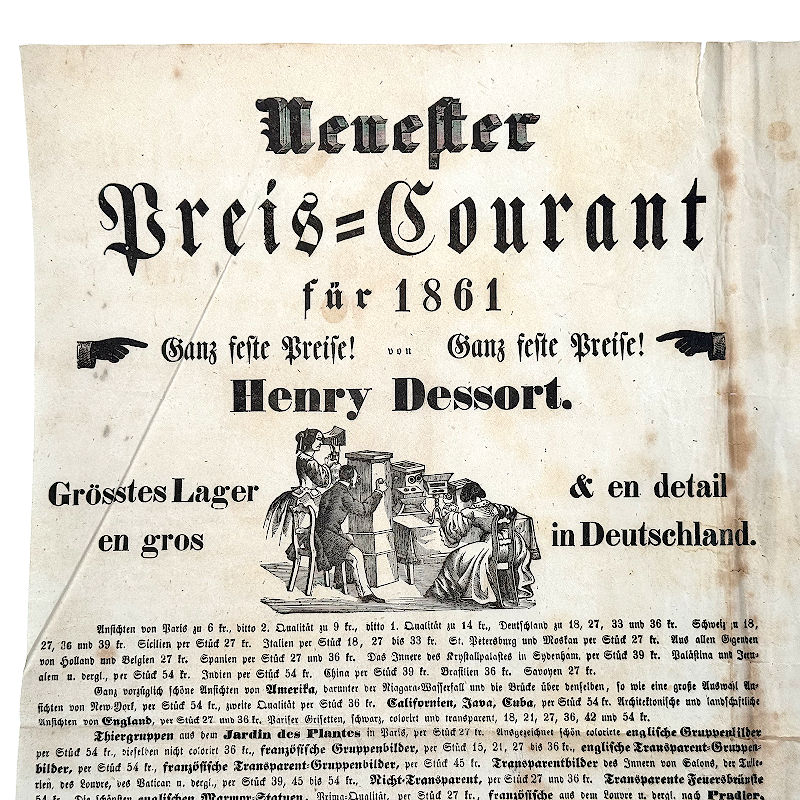
This unusually early German advertising broadside Neuester Preis-Courant, printed in Mainz by Carl Hellermann for Henry Dessort, presents an extensive range of stereoscopic photographs and viewing apparatus for 1861. Measuring 44x27cm, the single-sheet price list was intended for both retail and wholesale customers and advertised what Dessort called the largest stock of its kind in Germany.
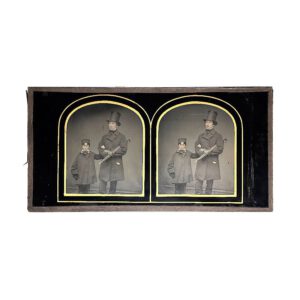
Most of the sheet is devoted to stereoscopic photographs. The subjects range across Europe and far beyond, including Paris, Switzerland, Italy, Spain, Russia, Palestine, India, China, Brazil and the United States. Views of Niagara Falls, New York and other well-known sites appear alongside portraits, genre scenes, coloured photographs and transparencies. A particularly large selection of glass stereoviews was also offered.
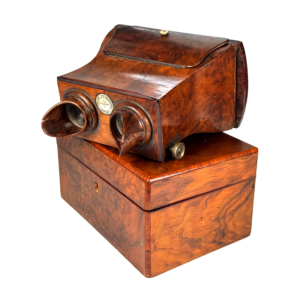
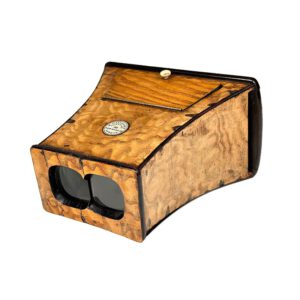
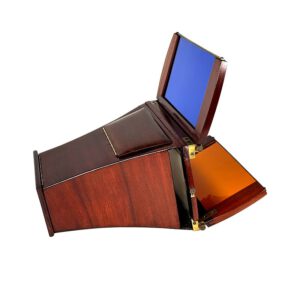
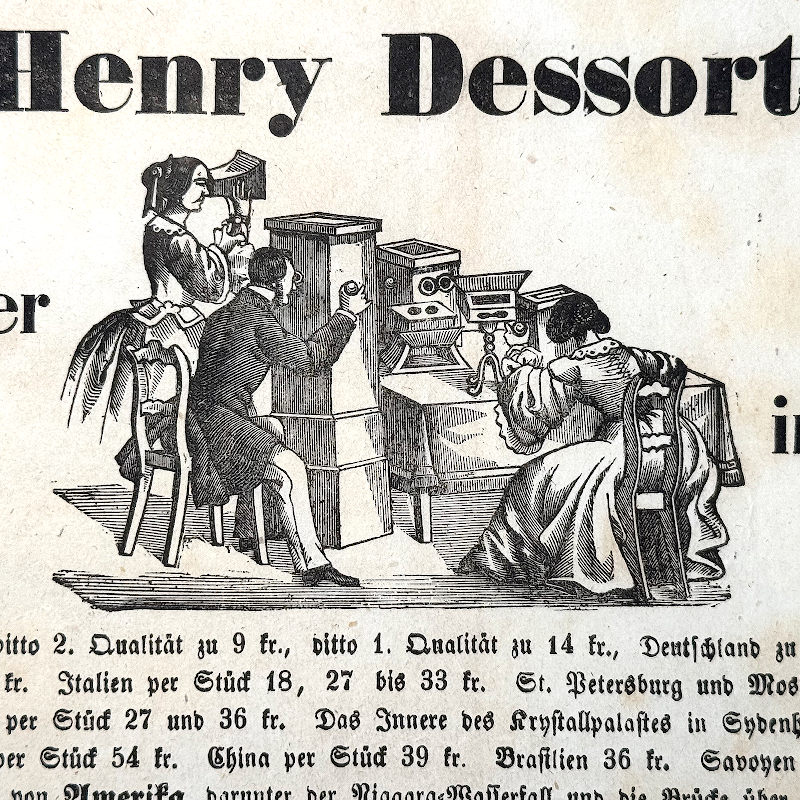
The lower part lists a wide variety of viewing apparatus, from simple stereoscopes and folding pocket models to diorama stereoscopes and mechanically operated devices capable of presenting multiple images. Prices ranged from inexpensive individual views to elaborate apparatus costing many guilders. Mail-order sales were available, with goods dispatched against advance payment or cash on delivery within the German Customs Union.
Dating from the first decade of stereoscopy’s rapid commercial expansion, the broadside is an unusually detailed source for the early stereoscopic trade. It documents not only the remarkable geographical range of images already available, but also the variety of viewing devices and the increasingly sophisticated distribution of stereoscopic photographs by the beginning of the 1860s.
Historical Context
Henry Dessort had already worked for many years as an exhibition proprietor before entering the stereoscopic trade. Finnish posters document Henri Dessort with circus and gymnastic performances in 1844. By the early 1850s his programme had expanded to large-scale visual attractions including panoramas, cycloramas and the Pleorama, in which moving painted scenery created the illusion of travelling through distant landscapes. Berlin newspaper advertisements from 1854 show that he presented these optical attractions alongside an anatomical and ethnological museum.
By 1860 Dessort was operating a Pleorama near the Heumarkt in Cologne, reportedly in a building erected specifically for the attraction. Advertisements in the Kölnische Zeitung also announce his Stéréoscope monstre, indicating that stereoscopy had become part of his exhibition activity as well as a commercial product. His 1861 price list, with its reference to 1,000 exhibited glass stereoviews, may therefore reflect a close connection between public stereoscopic display and the sale of photographs for private viewing.
Dessort also had strong connections with Elberfeld, today part of Wuppertal, where numerous advertisements for his stereoscopic business appeared in 1860 and 1861. Records held by the Landesarchiv Nordrhein-Westfalen provide a probable glimpse of his private life: a Heinrich Dessort, described as a director and born in Berlin, is recorded together with Wilhelmine Dessort, née Trojahn, and two daughters born in Elberfeld in 1856 and 1857. The family emigrated to Switzerland in 1870. Although definitive proof is still lacking, the unusual name, profession, places and chronology make the identification of this Heinrich Dessort with the showman and dealer Henri/Henry Dessort highly probable.